 01
01Human direction
Sets value, defines the objective, accepts risk, and retains consequential authority.
03 · How it works
The process begins with a human objective, sends clearly defined work to the smallest capable and authorized tool, returns results through validation and human authority, and records what happened for learning and recovery.
01Sets value, defines the objective, accepts risk, and retains consequential authority.
 02
02Frames the work, compiles authorized context, applies gates, routes capability, validates, and records.
Tools, private models, agents, and hosted AI perform the bounded work they are eligible to handle.
Rules, evidence, knowledge, decisions, workflow state, and recovery remain owned and portable.
The operating discipline
Each word names a control that must remain visible as work moves from a human objective to an operational result.
Define the objective, permitted context, constraints, authority, and stopping conditions before asking a capability to reason. The system solves a named problem instead of wandering through an open-ended prompt.
Select the lowest-cost eligible capability that can produce an accepted result. Privacy, risk, speed, quality, context, and verification requirements determine whether work stays local, uses a deterministic tool, calls a specialist model, or escalates to frontier intelligence. Results and corrections become evidence for the next routing decision.
Carry evidence, provenance, permissions, validation rules, and human decision rights with the work. Capability can analyze or propose without silently inheriting authority to approve, disclose, or act.
Turn an accepted result into controlled action, then record the outcome. Trace, replay, recovery, and learning close the loop so execution strengthens the organization’s durable intelligence.
Four operating principles
Knowledge, decisions, rules, and history remain portable instead of becoming inseparable from one AI product.
Source evidence, interpretation, inference, proposal, and human decision remain distinguishable, so every statement carries a visible basis and level of authority.
Permission to analyze is not permission to decide, disclose, approve, or execute.
Validation, trace, replay, manifests, and rollback reduce dependence on one model, interface, or runtime.
The management view
The process map shows how the framework and four operating principles guide work across four fixed roles.
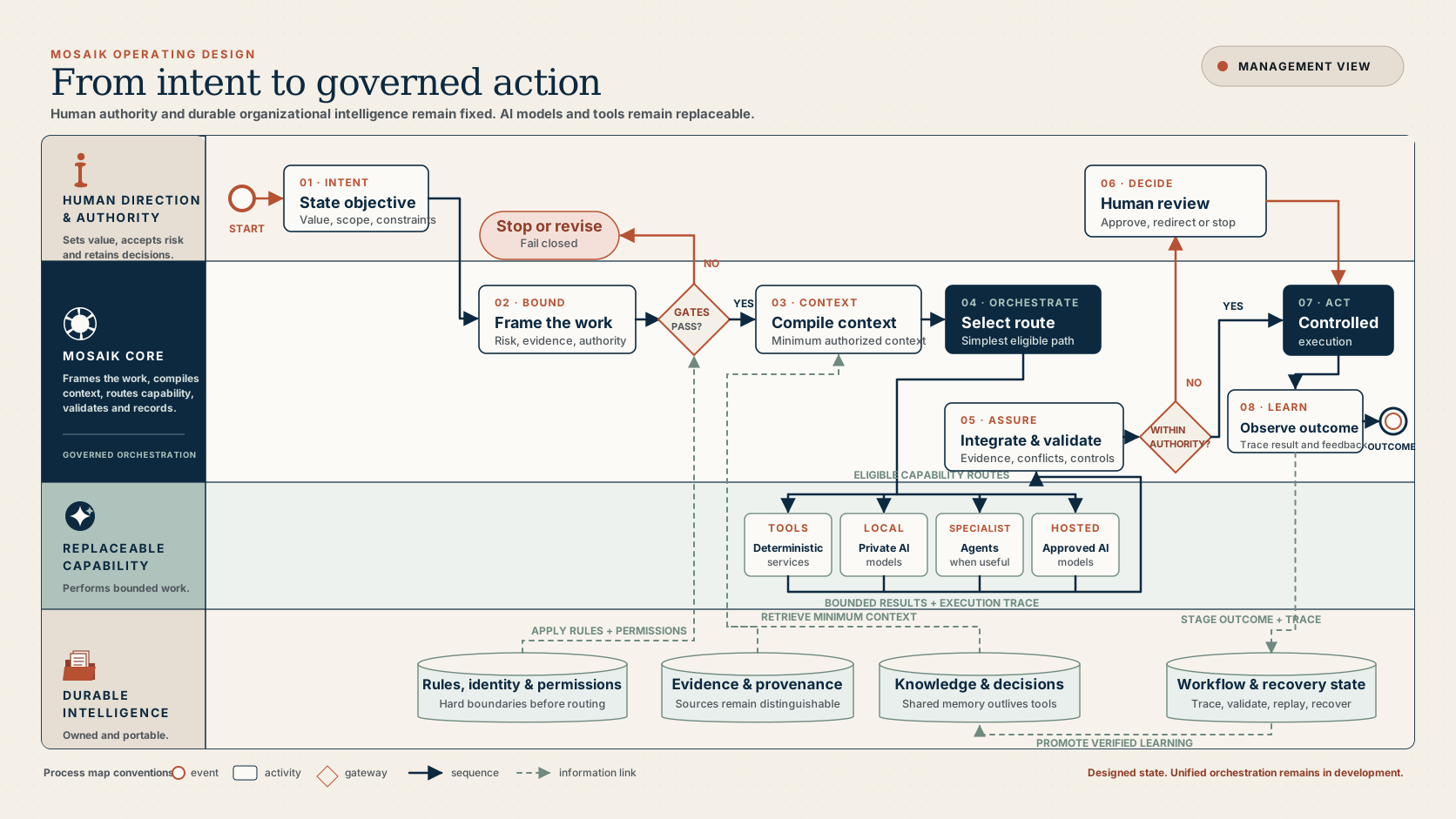
The process map shows the complete lifecycle. This expanded view explains what happens inside Bound, Context, Orchestrate, and Assure. These are designed controls being built and tested, not a claim that the complete orchestration layer is operational.
The orchestration layer
Ludwig is the intelligent orchestration layer being built for MOSAIK. Instead of expecting the user to know which model, tool, agent, context package, or privacy setting is best for every request, Ludwig will apply the rules, assemble the minimum authorized context, and route the work to the smallest eligible capability that can complete it well.
This is also a cost discipline. Straightforward work can remain local, use a deterministic tool, or call a smaller cloud model with less context. Specialist and frontier models are reserved for work whose complexity, risk, or uncertainty justifies their additional cost. The objective is not the cheapest response. It is the lowest-cost route to an accepted result.
The user keeps one coherent point of contact. Behind it, MOSAIK records which routes succeeded, what required correction, how much context and compute they consumed, and when escalation was necessary. Feedback, accepted results, and newly introduced models inform future routing decisions without requiring the user to become an expert in the changing capability market.
The expensive mistake is not paying for frontier intelligence. It is paying for frontier intelligence when the task never required it.
Governed continuity
MOSAIK is testing a controlled path from one episode to durable memory. The objective is continuity without allowing chat history, retrieval, or agent activity to become an unexamined source of truth.
Capture and structure what happened without pretending it has already earned durable authority.
Each ingested item resolves to an accepted, duplicate, excluded, or failed outcome instead of disappearing into a black box.
The task, evidence, route, outcome, and human boundary remain recoverable outside the original provider conversation.
Potential long-term memory becomes a reviewable proposal with provenance, sensitivity, confidence, and permitted-use rules.
Review, recall, and audit determine whether memory may shape later work and preserve the basis for that influence.
Corrections and consequential memory changes pass through the required human approval rather than silently rewriting history.
Only eligible memory enters context. Relevance and recency depend on the task, and an item-level trace records what influenced the result.
An append-only record retains the action, evidence, stable agent identity, session, approval, and recovery path even when credentials or providers change.